One key lesson becomes clear with experience in SAP:
SAP doesn’t run on transactions.
It runs on data.
It’s common to think SAP is primarily a transaction-driven system.
In reality, SAP operates through four core data types.
Every activity you see or perform in SAP is linked to one of these data types.
Once you understand them, SAP becomes far more predictable.
1. Configuration Data
Configuration data defines how SAP is designed to behave.
It determines:
- What is allowed
- What is restricted
- What runs automatically
- What triggers subsequent actions
When configuration is incorrect, SAP may continue to function — but not in line with business expectations.
These issues usually surface later, during testing, audits, or month-end close.
2. Master Data
Master data quality is not a technical issue; it is a business-wide dependency that directly affects daily operations.
Master data objects form the foundation of SAP.
When they are inaccurate or poorly governed, every dependent business process is impacted.
- Materials
Inaccurate or incomplete material data leads to incorrect planning, inventory imbalances, and procurement errors, resulting in excess stock, shortages, or incorrect cost reporting. - Vendors
Poor vendor master data affects purchasing, payments, and compliance. Duplicate records, incorrect payment details, or outdated terms can lead to payment delays, audit risks, and supplier disputes. - Equipment
Incorrect equipment data impacts maintenance planning and execution, leading to missed preventive maintenance, unreliable maintenance history, and poor asset performance reporting. - Functional Locations
Inconsistent or poorly structured functional location data reduces visibility into asset hierarchy and plant structure, resulting in incorrect work assignments and ineffective reporting.
SAP does not invent errors — it reflects the data it is given.
3. Transactional Data
This is where business execution takes place on a daily basis.
It includes activities such as:
- Notifications
- Work orders
- Procurement transactions
- Goods receipts and goods movements
This represents the real test of system design — validating the configuration and the master data.
When transactions become inefficient, the root cause usually lies elsewhere.
They are most often the result of weak configuration or poorly maintained master data.
Transactions do not correct design weaknesses — they expose them.
4. Security Data
Security data defines who can do what and who carries responsibility and risk.
Its purpose is to protect organisational data while enabling users to perform their assigned roles.
- User roles
- Authorizations
- Access levels
Security is not just an IT function; it is a critical business control.
- Excessive access increases conflict and audit exposure
- Insufficient access creates operational limitations and delays
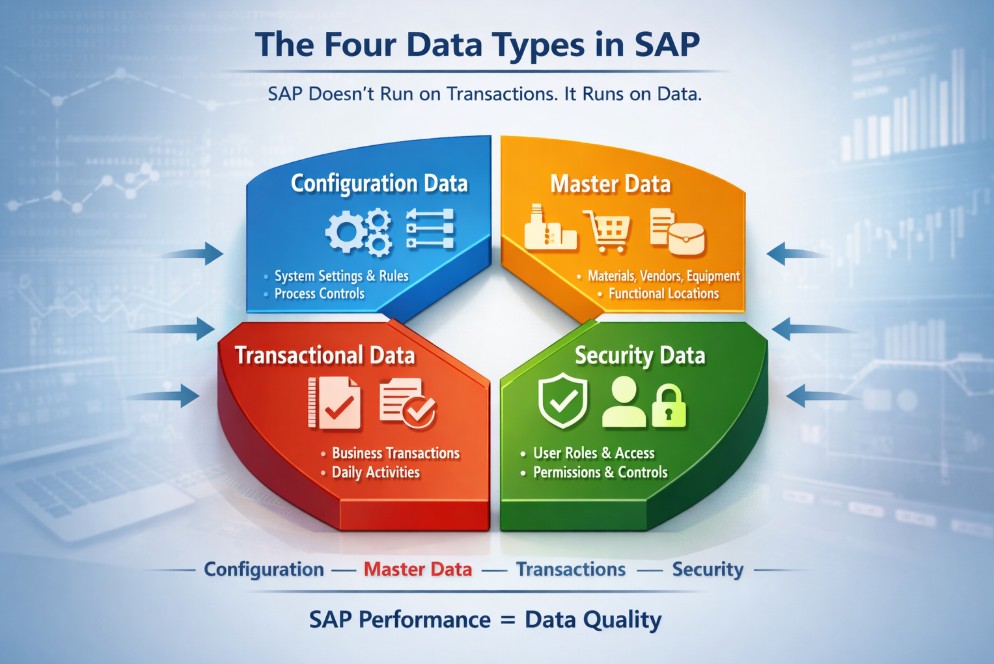
Image: A simple view of the four data types that drive SAP behaviour.
 Muhammad Hayat | SAP S/4HANA MM Consultant (Certified)
Leave a comment