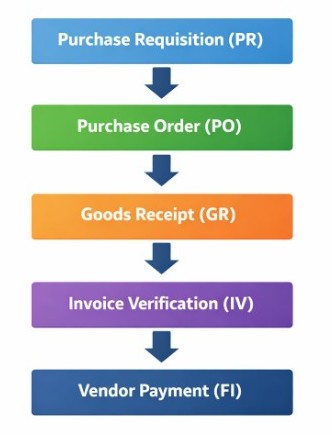
One of the most important processes in SAP Materials Management (MM) is the end-to-end procurement cycle, commonly referred to as Procure to Pay or P2P Process.
Understanding this process is critical not only for SAP consultants, but also for business users, as it shows how procurement activities flow seamlessly from a business requirement to vendor payment.
In this blog, I’ll explain the P2P Process in SAP S/4HANA MM in a clear, business-focused way, without diving into unnecessary technical complexity.
What is the Procure to Pay or P2P Process?
The P2P process covers the complete lifecycle of external procurement in SAP, starting from identifying a business need and ending with payment to the vendor.
At a high level, the process includes:
- Purchase Requisition (PR)
- Purchase Order (PO)
- Goods Receipt (GR)
- Invoice Verification (IV)
- Vendor Payment (FI Integration)
Each step plays a specific role and involves integration between SAP MM and Finance (FI).
1. Purchase Requisition (PR)
A Purchase Requisition represents an internal request to procure materials or services.
Key points:
- Created by business users, planners, or automatically via MRP
- Indicates what is needed, how much, and by when
- Does not go to the vendor
From a business perspective, the PR ensures that procurement starts with a genuine and approved requirement.
2. Purchase Order (PO)
A Purchase Order is the formal document sent to the vendor.
Key points:
- Created with reference to a PR or directly
- Contains vendor details, pricing, delivery dates, and terms
- Represents a legal commitment to purchase
In SAP S/4HANA, the PO is central to procurement control, as it drives downstream processes such as goods receipt and invoice verification.
3. Goods Receipt (GR)
A Goods Receipt confirms that the ordered materials have been physically received.
Key points:
- Updates stock levels in inventory
- Creates an accounting document automatically
- Posts to the GR/IR clearing account
From a control perspective, GR ensures that the business only pays for goods that are actually received.
4. Invoice Verification (IV)
Invoice Verification is where the vendor invoice is checked against the PO and GR.
Key points:
- SAP performs a 3-way match (PO, GR, Invoice)
- Price and quantity variances are identified
- Approved invoices are posted to Finance
This step is crucial for preventing overpayments and resolving discrepancies before payment.
5. Vendor Payment (FI Integration)
Once the invoice is posted, SAP Finance (FI) takes over.
Key points:
- Vendor open items are cleared during payment run
- Payment is made according to agreed terms
- Procurement cycle is formally closed
This step highlights the tight integration between SAP MM and FI, which is essential for accurate financial reporting.
Where SAP MM Owns the Process
SAP MM plays a key role across the procurement lifecycle:
- PR creation and processing
- PO creation and management
- Inventory updates through GR
- Invoice verification support
Finance (FI) becomes more dominant from invoice posting onwards, but MM remains critical for process accuracy.
Common Business Challenges in P2P
In real projects, I often see challenges such as:
- Poor material or vendor master data
- Delays due to approval workflows
- GR/IR mismatches
- Invoices posted without proper goods receipt
Understanding the end-to-end process helps identify and resolve these issues effectively.
Why End-to-End Process Understanding Matters
For SAP MM consultants and business users alike, understanding P2P Process is essential because:
- SAP is process-driven, not transaction-driven
- Errors at early stages impact downstream activities
- Strong process knowledge leads to better system design and smoother operations
SAP S/4HANA further reinforces this by encouraging Fit-to-Standard processes and minimizing unnecessary customization.
Final Thoughts
The P2P process is the backbone of procurement in SAP S/4HANA MM.
A clear understanding of this flow helps organizations improve control, transparency, and efficiency across procurement and finance.
Whether you’re a business user, consultant, or someone new to SAP MM, mastering this process is a foundational step toward working effectively with SAP.
About the Author
Muhammad Hayat, SAP MM Consultant, UK
 Muhammad Hayat | SAP S/4HANA MM Consultant (Certified)
Leave a comment